Plik:Sphere wireframe.svg
Przejdź do nawigacji
Przejdź do wyszukiwania
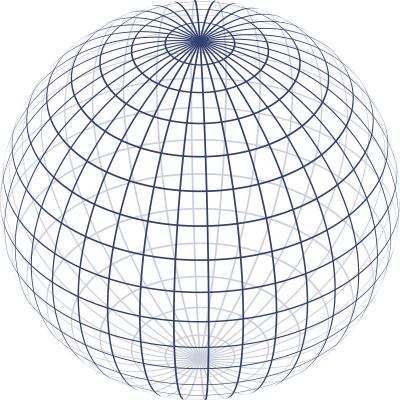
Wielkość pliku podglądu PNG dla pliku SVG: 400 × 400 pikseli Inne rozdzielczości: 240 × 240 pikseli | 480 × 480 pikseli | 768 × 768 pikseli | 1024 × 1024 pikseli | 2048 × 2048 pikseli.


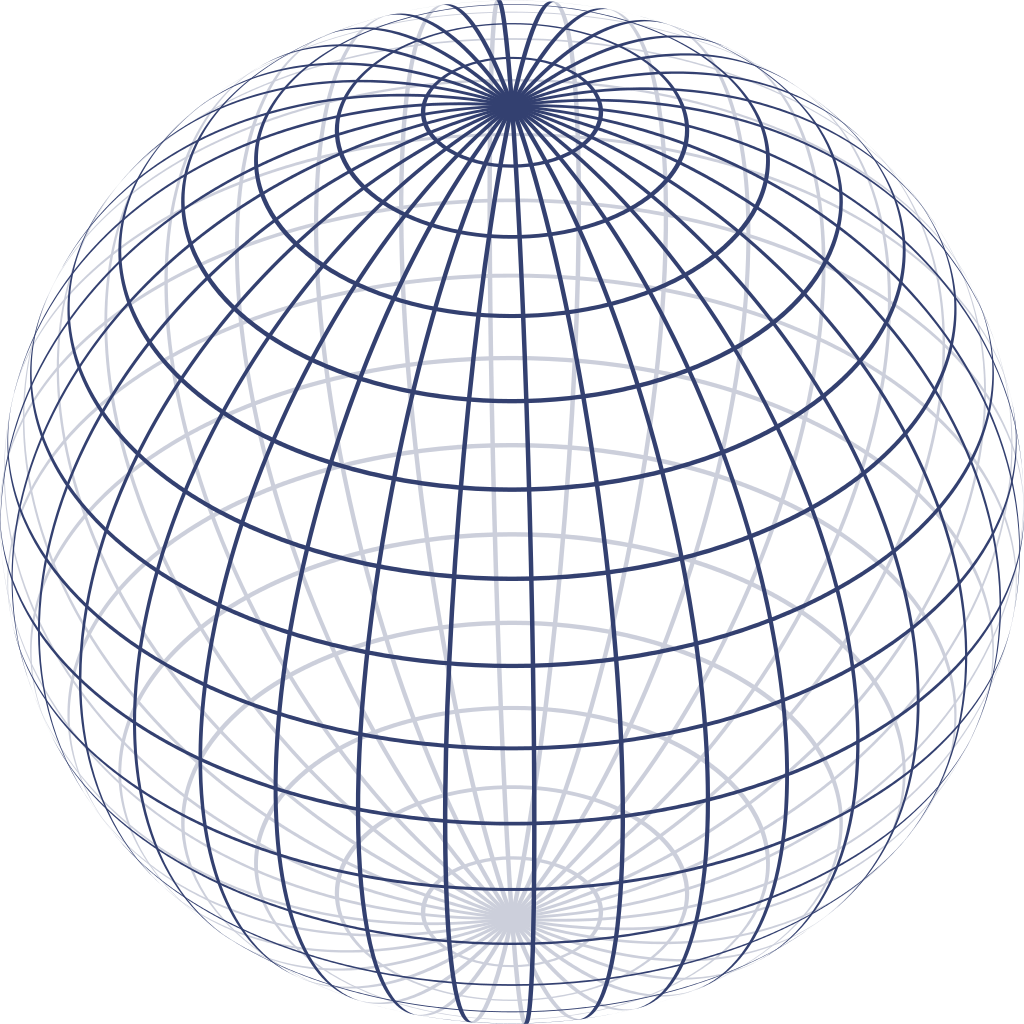
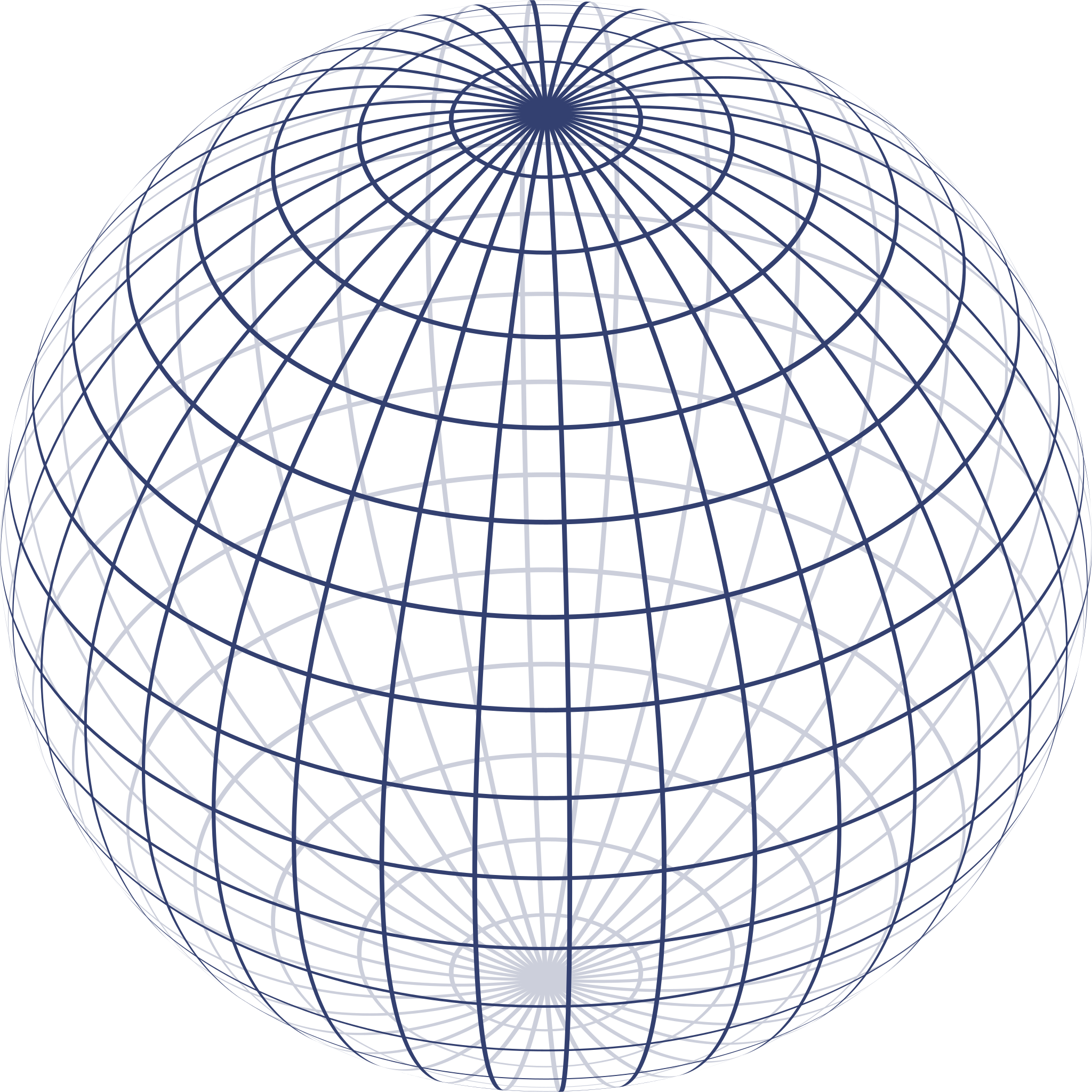
Rozmiar pierwotny (Plik SVG, nominalnie 400 × 400 pikseli, rozmiar pliku: 8 KB)

Opis
| Opis |
English: Sphere wireframe - orthogonal projection of a sphere. The image shows lines, which are drawn as they were painted onto the surface of a sphere. The angular distance between two lines is 10°. The SVG file is created by the below C++-program, which calculates each edge of a line as an ellipse-bow. The backside of the sphere has an opacity of 0.25. The axis tilt is 52.5°. |
| Data | |
| Źródło | Praca własna |
| Autor | Geek3 |
| Inne wersje | Sphere wireframe 10deg 10r.svg |


 W3C-validity not checked.
Source Code
This image can be completely generated by the following source code. If you have the gnu compiler collection installed, the programm can be compiled by the following commands:
g++ sphere_wireframe.cpp -o sphere_wireframe
and run :
./sphere_wireframe > Sphere_wireframe.svg
It creates file Sphere_wireframe.svg in working directory. This file can be viewed using rsvg-view program :
rsvg-view Sphere_wireframe.svg
Here is cpp code in file : sphere_wireframe.cpp
/* sphere - creates a svg vector-graphics file which depicts a wireframe sphere
 *
 * Copyright (C) 2008 Wikimedia foundation
 *
 * This program is free software; you can redistribute it and/or modify
 * it under the terms of the GNU General Public License as published by
 * the Free Software Foundation; either version 2, or (at your option)
 * any later version.
 *
 * This program is distributed in the hope that it will be useful,
 * but WITHOUT ANY WARRANTY; without even the implied warranty of
 * MERCHANTABILITY or FITNESS FOR A PARTICULAR PURPOSE.  See the
 * GNU General Public License for more details.
 *
 * You should have received a copy of the GNU General Public License
 * along with this program; if not, you can either send email to this
 * program's author (see below) or write to:
 *   The Free Software Foundation, Inc.
 *   51 Franklin Street, Fifth Floor
 *   Boston, MA 02110-1301  USA
 */

/* The expressions in this code are not proven to be correct.
 * Hence this code probably contains lots of bugs. Be aware! */

#include <iostream>
#include <cmath>
#include <cstdlib>
#include <cstring>

using namespace std;

const double PI = 3.1415926535897932;
const double DEG = PI / 180.0;

/********************************* settings **********************************/
int n_lon = 18; 			// number of latitude fields (18 => 10° each)
int n_lat = 18; 			// half number of longitude fields (18 => 10° each)
double lon_offset = 2.5 * DEG; 	// offset of the meridians
double w = 52.5 * DEG; 		// axial tilt (0° => axis is perpendicular to image plane)
double stripe_grad = 0.5 * DEG;	// width of each line
int image_size = 400;			// width and height of the image in pixels
double back_opacity = 0.25;		// opacity of the sphere's backside
char color[] = "#334070";		// color of lines
int istep = 2; 			// svg code indentation step
/*****************************************************************************/

double sqr(double x)
{
	return(x * x);
}

// commands for svg-code:
void indent(int n, bool in_tag = false)
{
	n *= istep;
	if (in_tag) n += istep + 1;
	for (int i = 0; i < n; i++) cout << " ";
}
void M()
{
	cout << "M ";
}
void Z()
{
	cout << "Z ";
}
void xy(double x, double y)
{
	cout << x << ",";
	cout << y << " ";
}
void arc(double a, double b, double x_axis_rot, bool large_arc, bool sweep)
{	// draws an elliptic arc
	if (b < 0.5E-6)
	{	// flat ellipses are not rendered properly => use line
		cout << "L ";
	}
	else
	{
		cout << "A ";
		cout << a << ",";	// semi-major axis
		cout << b << " ";	// semi-minor axis
		cout << x_axis_rot << " ";
		cout << large_arc << " ";
		cout << sweep << " ";
	}
}
void circle(bool clockwise)
{
	M();
	xy(-1, 0);
	arc(1, 1, 0, 0, !clockwise);
	xy(1, 0);
	arc(1, 1, 0, 0, !clockwise);
	xy(-1, 0);
	Z();
}

void start_svg_file()
{
	cout << "<?xml version=\"1.0\" encoding=\"UTF-8\" standalone=\"no\"?>\n";
	cout << "<svg id=\"Sphere_wireframe\"\n";
	cout << "  version=\"1.1\"\n";
	cout << "  baseProfile=\"full\"\n";
	cout << "  xmlns=\"http://www.w3.org/2000/svg\"\n";
	cout << "  xmlns:xlink=\"http://www.w3.org/1999/xlink\"\n";
	cout << "  width=\"" << image_size << "\"\n";
	cout << "  height=\"" << image_size << "\">\n\n";
	cout << "  <title>Sphere wireframe</title>\n\n";
	cout << "  <desc>\n";
	cout << "     about: http://commons.wikimedia.org/wiki/Image:Sphere_wireframe.svg\n";
	cout << "     rights: GNU Free Documentation license,\n";
	cout << "             Creative Commons Attribution ShareAlike license\n";
	cout << "  </desc>\n\n";
	cout << "  <g id=\"sphere\" transform=\"scale(" << 0.5 * image_size;
	cout << ", " << -0.5 * image_size << ") translate(1, -1)\">\n";
}

void end_svg_file()
{
	cout << "  </g>\n</svg>\n";
}


int main (int argc, char *argv[])
{
	// accept -lat and -lon as parameter
	for (int i = 2; i < argc; i++)
	{
		if (isdigit(argv[i][0]) || (sizeof(argv[i]) > sizeof(char)
			&& isdigit(argv[i][1])
			&& (argv[i][0] == '.' || argv[i][0] == '-')))
		{
			if (strcmp(argv[i - 1], "-lon") == 0)
			{
				lon_offset = atof(argv[i]) * DEG;
			}
			if (strcmp(argv[i - 1], "-lat") == 0)
			{
				w = atof(argv[i]) * DEG;
			}
		}
	}
	double cosw = cos(w), sinw = sin(w);
	double d = 0.5 * stripe_grad;

	start_svg_file();
	int ind = 2; // initial indentation level
	indent(ind);
	cout << "<g id=\"sphere_back\" transform=\"rotate(180)\" ";
	cout << "opacity=\"" << back_opacity << "\">\n";
	indent(++ind);
	cout << "<g id=\"sphere_half\">\n";

	// meridians
	indent(++ind); cout << "<g id=\"meridians\"\n";
	indent(ind++, true);
	cout << "style=\"stroke:none; fill:" << color << "; fill_rule:evenodd\">\n";
	double a = abs(cos(d));
	for (int i_lon = 0; i_lon < n_lat; i_lon++)
	{	// draw one meridian
		double longitude = lon_offset + (i_lon * 180.0 / n_lat) * DEG;
		double lon[2];
		lon[0] = longitude + d;
		lon[1] = longitude - d;

		indent(ind);
		cout << "<path id=\"meridian";
		cout << i_lon << "\"\n";
		indent(ind, true);
		cout << "d=\"";

		double axis_rot = atan2(-1.0 / tan(longitude), cosw);
		if (sinw < 0)
			axis_rot += PI;
		double w2 = sin(longitude) * sinw;
		double b = abs(w2 * cos(d));

		double sinw1 = sin(d) / sqrt(1.0 - sqr(sin(longitude) * sinw));

		if (abs(sinw1) >= 1.0)
		{	// stripe covers edge of the circle
			double w3 = sqrt(1.0 - sqr(w2)) * sin(d);
			circle(false);
			// ellipse
			M();
			xy(sin(axis_rot) * w3 - cos(axis_rot) * a,
				-cos(axis_rot) * w3 - sin(axis_rot) * a);
			arc(a, b, axis_rot / DEG, 0, 0);
			xy(sin(axis_rot) * w3 + cos(axis_rot) * a,
				-cos(axis_rot) * w3 + sin(axis_rot) * a);
			arc(a, b, axis_rot / DEG, 0, 0);
			xy(sin(axis_rot) * w3 - cos(axis_rot) * a,
				-cos(axis_rot) * w3 - sin(axis_rot) * a);
			Z();
		}
		else
		{	// draw a disrupted ellipse bow
			double w1 = asin(sinw1);
			M();
			xy(-cos(axis_rot + w1), -sin(axis_rot + w1));
			arc(a, b, axis_rot / DEG, 1, 0);
			xy(cos(axis_rot - w1), sin(axis_rot - w1));
			arc(1, 1, 0, 0, 1);
			xy(cos(axis_rot + w1), sin(axis_rot + w1));
			arc(a, b, axis_rot / DEG, 0, 1);
			xy(-cos(axis_rot - w1), -sin(axis_rot - w1));
			arc(1, 1, 0, 0, 1);
			xy(-cos(axis_rot + w1), -sin(axis_rot + w1));
		}
		Z();
		cout << "\" />\n";
	}
	indent(--ind); cout << "</g>\n";

	cout << endl;

	// circles of latitude
	indent(ind); cout << "<g id=\"circles_of_latitude\"\n";
	indent(ind, true);
	cout << "style=\"stroke:none; fill:" << color << "; fill_rule:evenodd\">\n";
	ind++;
	for (int i_lat = 1; i_lat < n_lon; i_lat++)
	{	// draw one circle of latitude
		double latitude = (i_lat * 180.0 / n_lon - 90.0) * DEG;
		double lat[2];
		lat[0] = latitude + d;
		lat[1] = latitude - d;
		double x[2], yd[2], ym[2];
		for (int i = 0; i < 2; i++)
		{
			x[i] = abs(cos(lat[i]));
			yd[i] = abs(cosw * cos(lat[i]));
			ym[i] = sinw * sin(lat[i]);
		}
		double h[4];	// height of each point above image plane
		h[0] = sin(lat[0] + w);
		h[1] = sin(lat[0] - w);
		h[2] = sin(lat[1] + w);
		h[3] = sin(lat[1] - w);

		if (h[0] > 0 || h[1] > 0 || h[2] > 0 || h[3] > 0)
		{	// at least any part visible
			indent(ind);
			cout << "<path id=\"circle_of_latitude";
			cout << i_lat << "\"\n";
			indent(ind, true);
			cout << "d=\"";
			for (int i = 0; i < 2; i++)
			{
				if ((h[2*i] >= 0 && h[2*i+1] >= 0)
					&& (h[2*i] > 0 || h[2*i+1] > 0))
				{	// complete ellipse
					M();
					xy(-x[i], ym[i]); // startpoint
					for (int z = 1; z > -2; z -= 2)
					{
						arc(x[i], yd[i], 0, 1, i);
						xy(z * x[i], ym[i]);
					}
					Z();
					if (h[2-2*i] * h[3-2*i] < 0)
					{	// partly ellipse + partly circle
						double yp = sin(lat[1-i]) / sinw;
						double xp = sqrt(1.0 - sqr(yp));
						if (sinw < 0)
						{
							xp = -xp;
						}
						M();
						xy(-xp, yp);
						arc(x[1-i], yd[1-i], 0,
							sin(lat[1-i]) * cosw > 0, cosw >= 0);
						xy(xp, yp);
						arc(1, 1, 0, 0, cosw >= 0);
						xy(-xp, yp);
						Z();
					}
					else if (h[2-2*i] <= 0 && h[3-2*i] <= 0)
					{	// stripe covers edge of the circle
						circle(cosw < 0);
					}
				}
			}

			if ((h[0] * h[1] < 0 && h[2] <= 0 && h[3] <= 0)
				|| (h[0] <= 0 && h[1] <= 0 && h[2] * h[3] < 0))
			{
				// one slice visible
				int i = h[0] <= 0 && h[1] <= 0;
				double yp = sin(lat[i]) / sinw;
				double xp = sqrt(1.0 - yp * yp);
				M();
				xy(-xp, yp);
				arc(x[i], yd[i], 0, sin(lat[i]) * cosw > 0, cosw * sinw >= 0);
				xy(xp, yp);
				arc(1, 1, 0, 0, cosw * sinw < 0);
				xy(-xp, yp);
				Z();
			}
			else if (h[0] * h[1] < 0 && h[2] * h[3] < 0)
			{
				// disrupted ellipse bow
				double xp[2], yp[2];
				for (int i = 0; i < 2; i++)
				{
					yp[i] = sin(lat[i]) / sinw;
					xp[i] = sqrt(1.0 - sqr(yp[i]));
					if (sinw < 0) xp[i] = -xp[i];
				}
				M();
				xy(-xp[0], yp[0]);
				arc(x[0], yd[0], 0, sin(lat[0]) * cosw > 0, cosw >= 0);
				xy(xp[0], yp[0]);
				arc(1, 1, 0, 0, 0);
				xy(xp[1], yp[1]);
				arc(x[1], yd[1], 0, sin(lat[1]) * cosw > 0, cosw < 0);
				xy(-xp[1], yp[1]);
				arc(1, 1, 0, 0, 0);
				xy(-xp[0], yp[0]);
				Z();
			}
			cout << "\" />\n";
		}
	}
	for (int i = 0; i < 3; i++)
	{
		indent(--ind);
		cout << "</g>\n";
	}
	indent(ind--);
	cout << "<use id=\"sphere_front\" xlink:href=\"#sphere_half\" />\n";
	end_svg_file();
}
Licencja
Ja, właściciel praw autorskich do tego dzieła, udostępniam je na poniższych licencjach

|
Udziela się zgody na kopiowanie, rozpowszechnianie oraz modyfikowanie tego dokumentu zgodnie z warunkami GNU Licencji Wolnej Dokumentacji, w wersji 1.2 lub nowszej opublikowanej przez Free Software Foundation; bez niezmiennych sekcji, bez treści umieszczonych na frontowej lub tylnej stronie okładki. Kopia licencji załączona jest w sekcji zatytułowanej GNU Licencja Wolnej Dokumentacji. |


Ten plik udostępniony jest na licencji Creative Commons Uznanie autorstwa–na tych samych warunkach 3.0 niezlokalizowana, 2.5 zlokalizowana, 2.0 zlokalizowana oraz 1.0 zlokalizowana.
- Wolno:
- dzielić się – kopiować, rozpowszechniać, odtwarzać i wykonywać utwór
- modyfikować – tworzyć utwory zależne
- Na następujących warunkach:
- uznanie autorstwa – musisz określić autorstwo utworu, podać link do licencji, a także wskazać czy utwór został zmieniony. Możesz to zrobić w każdy rozsądny sposób, o ile nie będzie to sugerować, że licencjodawca popiera Ciebie lub Twoje użycie utworu.
- na tych samych warunkach – Jeśli zmienia się lub przekształca niniejszy utwór, lub tworzy inny na jego podstawie, można rozpowszechniać powstały w ten sposób nowy utwór tylko na podstawie tej samej lub podobnej licencji.
Możesz wybrać, którą licencję chcesz zastosować.
Historia pliku
Kliknij na datę/czas, aby zobaczyć, jak plik wyglądał w tym czasie.
| Data i czas | Miniatura | Wymiary | Użytkownik | Opis | |
|---|---|---|---|---|---|
| aktualny | 17:10, 23 lis 2008 | | 400 × 400 (8 KB) | wikimediacommons>Geek3 | {{Information |Description={{en|1=Sphere wireframe - the image shows lines, which are drawn as they were painted onto the surface of a sphere. The distance between two lines is 10°. The svg file is created by the below c++-program, which calculates each |
Lokalne wykorzystanie pliku
Poniższa strona korzysta z tego pliku:
