Plik:QuantumHarmonicOscillatorAnimation.gif
Przejdź do nawigacji
Przejdź do wyszukiwania
Grafika w wyższej rozdzielczości nie jest dostępna.
QuantumHarmonicOscillatorAnimation.gif (300 × 373 pikseli, rozmiar pliku: 759 KB, typ MIME: image/gif, zapętlony, 97 klatek)

Opis
| Opis |
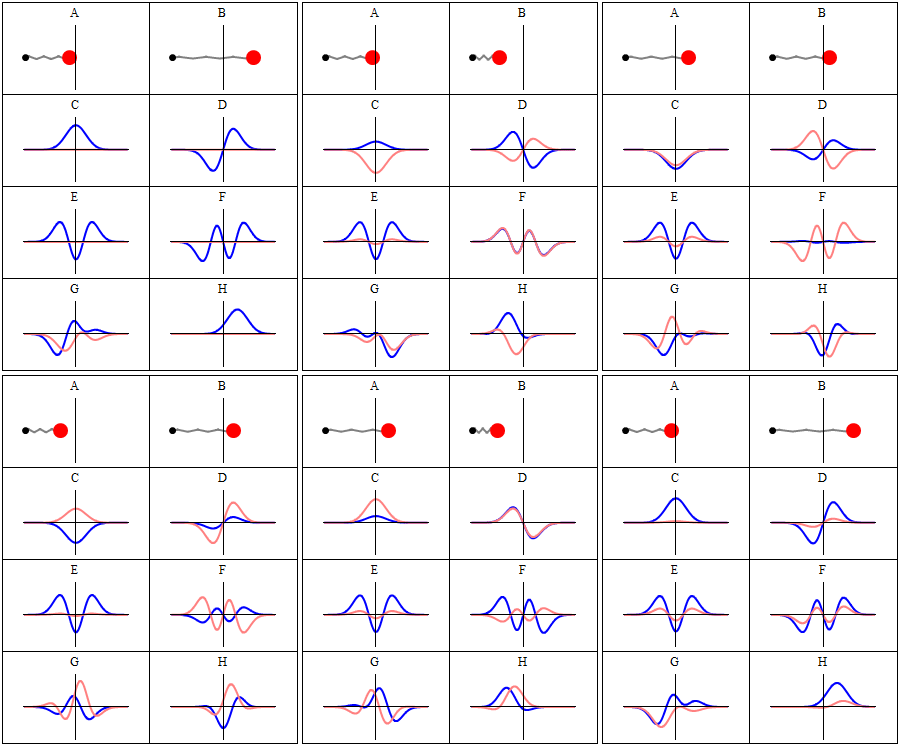
English: A harmonic oscillator in classical mechanics (A-B) and quantum mechanics (C-H). In (A-B), a ball, attached to a spring (gray line), oscillates back and forth. In (C-H), wavefunction solutions to the Time-Dependent Schrödinger Equation are shown for the same potential. The horizontal axis is position, the vertical axis is the real part (blue) or imaginary part (red) of the wavefunction. (C,D,E,F) are stationary states (energy eigenstates), which come from solutions to the Time-Independent Schrodinger Equation. (G-H) are non-stationary states, solutions to the Time-Dependent but not Time-Independent Schrödinger Equation. (G) is a randomly-generated superposition of the four states (E-F). H is a "coherent state" ("Glauber state") which somewhat resembles the classical state B.
العربية: مذبذب توافقي في الميكانيكا الكلاسيكية (A-B) وميكانيكا الكم (C-H). في (A-B)، كرة متصلة بنابض (خط رمادي)، تتأرجح ذهابًا وإيابًا. في (C-H)، يعرض حلول الدالة الموجية لمعادلة شرودنغر المعتمدة على الوقت لنفس الإمكانات. المحور الأفقي هو الموضع، والمحور العمودي هو الجزء الحقيقي (الأزرق) أو الجزء التخيلي (الأحمر) من دالة الموجة. (C ،D ،E ،F) هي حالات ثابتة (حالات الطاقة الذاتية)، والتي تأتي من حلول معادلة شرودنغر المستقلة عن الزمن. (G-H) هي حالات غير ثابتة، وهي حلول لمعادلة شرودنغر التي تعتمد على الوقت ولكنها ليست مستقلة عن الوقت. (G) هو تراكب أنشىء عشوائيًا للحالات الأربع (E-F). H هي "حالة متماسكة" ("حالة جلوبر") تشبه إلى حد ما الحالة الكلاسيكية B. |
| Data | |
| Źródło | Praca własna |
| Autor | Sbyrnes321 |
(* Source code written in Mathematica 6.0 by Steve Byrnes, Feb. 2011. This source code is public domain. *)
(* Shows classical and quantum trajectory animations for a harmonic potential. Assume m=w=hbar=1. *)
ClearAll["Global`*"]
(*** Wavefunctions of the energy eigenstates ***)
psi[n_, x_] := (2^n*n!)^(-1/2)*Pi^(-1/4)*Exp[-x^2/2]*HermiteH[n, x];
energy[n_] := n + 1/2;
psit[n_, x_, t_] := psi[n, x] Exp[-I*energy[n]*t];
(*** A random time-dependent state ***)
SeedRandom[1];
CoefList = Table[Random[]*Exp[2 Pi I Random[]], {n, 0, 4}];
CoefList = CoefList/Norm[CoefList];
Randpsi[x_, t_] := Sum[CoefList[[n + 1]]*psit[n, x, t], {n, 0, 4}];
(*** A coherent state (or "Glauber state") ***)
CoherentState[b_, x_, t_] := Exp[-Abs[b]^2/2] Sum[b^n*(n!)^(-1/2)*psit[n, x, t], {n, 0, 15}];
(*** Make the classical plots...a red ball anchored to the origin by a gray spring. ***)
classical1[t_, max_] := ListPlot[{{max Cos[t], 0}}, PlotStyle -> Directive[Red, AbsolutePointSize[15]]];
zigzag[x_] := Abs[(x + 0.25) - Round[x + 0.25]] - .25;
spring[x_, left_, right_] := (.9 zigzag[3 (x - left)/(right - left)])/(1 + Abs[right - left]);
classical2[t_, max_] := Plot[spring[x, -5, max Cos[t]], {x, -5, max Cos[t]}, PlotStyle -> Directive[Gray, Thick]];
classical3 = ListPlot[{{-5, 0}}, PlotStyle -> Directive[Black, AbsolutePointSize[7]]];
classical[t_, max_, label_] := Show[classical2[t, max], classical1[t, max], classical3,
   PlotRange -> {{-5, 5}, {-1, 1}}, Ticks -> None, Axes -> {False, True}, PlotLabel -> label, AxesOrigin -> {0, 0}];
(*** Put all the plots together ***)
SetOptions[Plot, {PlotRange -> {-1, 1}, Ticks -> None, PlotStyle -> {Directive[Thick, Blue], Directive[Thick, Pink]}}];
MakeFrame[t_] := GraphicsGrid[
   {{classical[t + 2, 1.5, "A"], classical[t, 3, "B"]},
    {Plot[{Re[psit[0, x, t]], Im[psit[0, x, t]]}, {x, -5, 5}, PlotLabel -> "C"],
     Plot[{Re[psit[1, x, t]], Im[psit[1, x, t]]}, {x, -5, 5}, PlotLabel -> "D"]},
    {Plot[{Re[psit[2, x, t]], Im[psit[2, x, t]]}, {x, -5, 5}, PlotLabel -> "E"],
     Plot[{Re[psit[3, x, t]], Im[psit[3, x, t]]}, {x, -5, 5}, PlotLabel -> "F"]},
    {Plot[{Re[Randpsi[x, t]], Im[Randpsi[x, t]]}, {x, -5, 5}, PlotLabel -> "G"],
     Plot[{Re[CoherentState[1, x, t]], Im[CoherentState[1, x, t]]}, {x, -5, 5}, PlotLabel -> "H"]}
    }, Frame -> All, ImageSize -> 300];
output = Table[MakeFrame[t], {t, 0, 4 Pi*96/97, 4 Pi/97}];
SetDirectory["C:\\Users\\Steve\\Desktop"]
Export["test.gif", output]
Licencja
Ja, właściciel praw autorskich do tego dzieła, udostępniam je na poniższej licencji
 
|
Ten plik udostępniony jest na licencji Creative Commons CC0 1.0 Uniwersalna Licencja Domeny Publicznej. |
| Osoby, które współpracowały przy tworzeniu tego utworu przeniosły go do domeny publicznej poprzez zrezygnowanie ze wszystkich przysługujących im praw na obszarze całego świata z tytułu prawa autorskiego oraz wszystkich powiązanych i podobnych praw, w zakresie dopuszczalnym przez prawo. Możesz kopiować, zmieniać, rozprowadzać i wykonywać to dzieło, nawet wykorzystując do celów komercyjnych bez pytania o pozwolenie.
|
Historia pliku
Kliknij na datę/czas, aby zobaczyć, jak plik wyglądał w tym czasie.
| Data i czas | Miniatura | Wymiary | Użytkownik | Opis | |
|---|---|---|---|---|---|
| aktualny | 10:16, 2 mar 2011 | | 300 × 373 (759 KB) | wikimediacommons>Sbyrnes321 | Alter spring, to avoid the visual impression that the ball is rotating in a circle around the y-axis through the third dimension. |
Lokalne wykorzystanie pliku
Poniższa strona korzysta z tego pliku:
