Plik:PIA19716 Alice Solar Occultation.jpg
Przejdź do nawigacji
Przejdź do wyszukiwania
Rozmiar podglądu – 800 × 450 pikseli. Inne rozdzielczości: 320 × 180 pikseli | 640 × 360 pikseli | 1280 × 720 pikseli.
Rozmiar pierwotny (1280 × 720 pikseli, rozmiar pliku: 243 KB, typ MIME: image/jpeg)
Opis
| Opis |
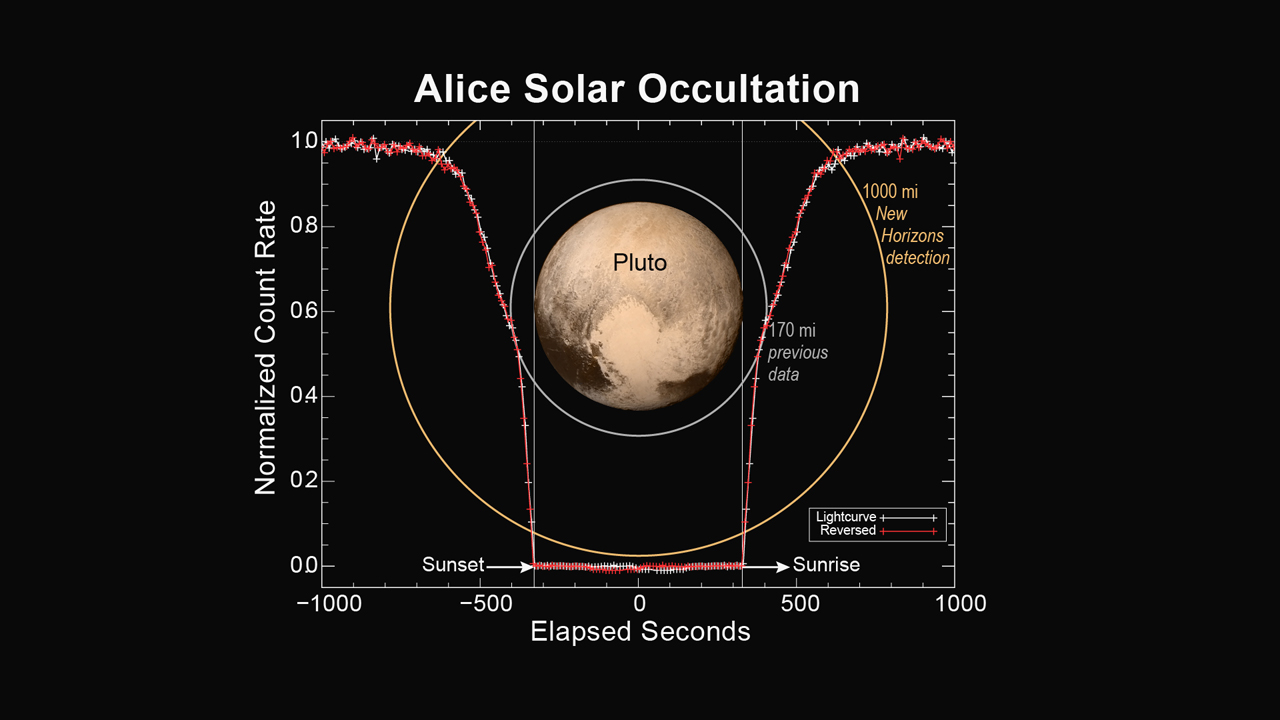
English: This figure shows how the Alice instrument count rate changed over time during the sunset and sunrise observations. The count rate is largest when the line of sight to the sun is outside of the atmosphere at the start and end times. Molecular nitrogen (N2) starts absorbing sunlight in the upper reaches of Pluto's atmosphere, decreasing as the spacecraft approaches the planet's shadow. As the occultation progresses, atmospheric methane and hydrocarbons can also absorb the sunlight and further decrease the count rate. When the spacecraft is totally in Pluto's shadow the count rate goes to zero. As the spacecraft emerges from Pluto's shadow into sunrise, the process is reversed. By plotting the observed count rate in the reverse time direction, it is seen that the atmospheres on opposite sides of Pluto are nearly identical.
The Johns Hopkins University Applied Physics Laboratory in Laurel, Maryland, designed, built, and operates the New Horizons spacecraft, and manages the mission for NASA's Science Mission Directorate. The Southwest Research Institute, based in San Antonio, leads the science team, payload operations and encounter science planning. New Horizons is part of the New Frontiers Program managed by NASA's Marshall Space Flight Center in Huntsville, Alabama. |
| Data | (published) |
| Źródło | Catalog page · Full-res (JPEG · TIFF) |
| Autor | NASA/Johns Hopkins University Applied Physics Laboratory/Southwest Research Institute |
| Inne wersje |
|

.jpg)



|
Ta grafika lub film został skatalagowany przez Jet Propulsion Lab Stanów Zjednoczonych Ameryki National Aeronautics and Space Administration (NASA)pod Photo ID: PIA19715. Ten szablon nie wskazuje stanu prawnego pliku. Standardowy szablon licencji jest nadal wymagany. Aby dowiedzieć się więcej, zajrzyj na stronę Commons:Licencja. Inne języki:
|
 |
This media is a product of the New Horizons mission Credit and attribution belongs to the Alice UV Spectrometer team, NASA/Johns Hopkins University Applied Physics Laboratory/Southwest Research Institute |
Licencja

|
Ten plik jest w domenie publicznej ponieważ został stworzony przez NASA. Polityka praw autorskich NASA stwierdza, że „materiały NASA nie są chronione prawami autorskimi, chyba że zapisano inaczej”. (NASA copyright policy lub JPL Image Use Policy). |  |
 |
Uwaga:
|
Historia pliku
Kliknij na datę/czas, aby zobaczyć, jak plik wyglądał w tym czasie.
| Data i czas | Miniatura | Wymiary | Użytkownik | Opis | |
|---|---|---|---|---|---|
| aktualny | 04:58, 23 gru 2018 | | 1280 × 720 (243 KB) | wikimediacommons>PhilipTerryGraham | Reverted to version as of 02:26, 14 November 2018 (UTC) Please upload it as a seperate file |
Lokalne wykorzystanie pliku
Żadna strona nie korzysta z tego pliku.
