Plik:Early Lecher line.png
Opis
| Opis |
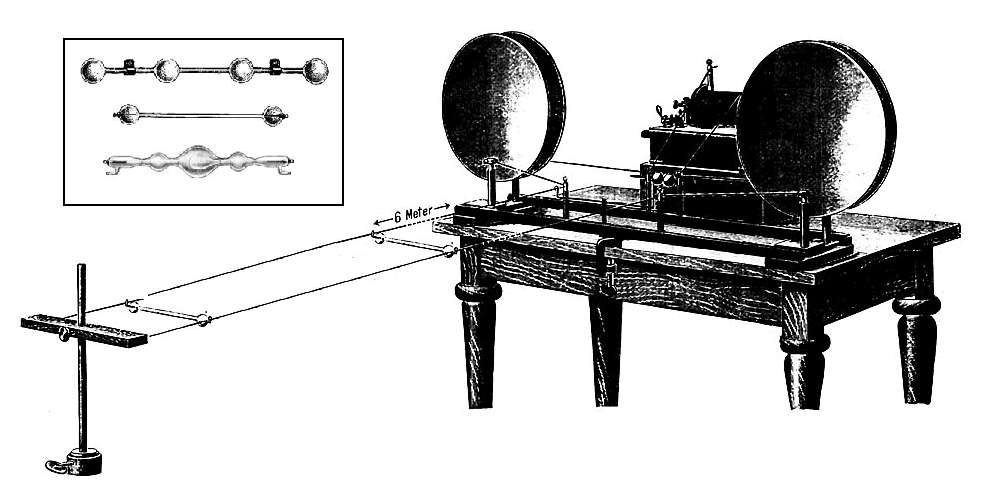
English: Drawing of an early demonstration Lecher line apparatus, from a 1902 catalog of scientific equipment. It is very similar to the first Lecher line built by Austrian physicist Ernst Lecher in 1888. A Lecher line is a pair of parallel wires or rods that were used to measure the wavelength of radio waves. In this example, the radio waves are generated by the Hertzian spark-gap oacillator (right) and sent down the Lecher line, the pair of parallel wires to the left. The Lecher line forms a length of balanced transmission line, along which the waves travel at the speed of light. At the left end of the line the two wires are connected together. This short-circuit termination reflects the waves back up the line toward the transmitter. The outgoing and reflected waves interfere with each other, creating a series of standing waves on the line. The voltage across the line goes to zero at nodes that occur at regular intervals of one-half wavelength (λ/2) from the end of the line. The distance between two nodes is measured and multiplied by two to get the wavelength λ. Since the waves travel at the speed of light, c, the frequency of the waves f can be calculated:
To find the location of the nodes, a Geissler tube, similar to a small neon light, is suspended from hooks across the line and slid up and down the line. The high voltage waves cause it to glow. At the nodes the voltage goes to zero so the Geissler tube goes out. The inset (top left) shows the type of Geissler tubes that were used with Lecher lines. The Hertzian oscillator (right) generated radio waves in the UHF range, with wavelengths of a few meters, so a 6 meter Lecher line was used (the length is truncated in this drawing). The oscillator consists of an induction coil that generates a high voltage that jumps across a spark gap (center) many times per second. The two sides of the spark gap are coupled to the Lecher line through two parallel-plate capacitors (circles). The energy stored in the capacitors is discharged into the line during each spark, generating a brief oscillating radio wave (damped wave) that decays to zero. The symmetrical balanced circuit ensures that equal and opposite voltage waves are induced in each wire. Alterations to image: extended the length of the Lecher line, which was misleadingly shortened to several inches long in the original drawing to save space. Added inset showing closeup of Geissler tubes from nearby drawing in same source.Deutsch: Dieses Stehwellenmessgerät wurde 1888 vom Physiker Ernst Lecher entwickelt, um Wellenlängen und Frequenzen zu messen. Die Abbildung stammt aus einem Katalog für wissenschaftliche Laborausrüstung aus dem Jahr 1904 und ist für Wellenlängen um 1 m geeignet. |
| Data | |
| Źródło | Downloaded 2010-11-16 from Physikalische Apparate, Preisliste No. 18 (1904) Ferdinand Ernecke, Berlin, Germany, p.304, fig. 8800 in Instruments for Science collection, Smithsonian Institution |
| Autor | Nieznany |
| Licencja (Ponowne użycie tego pliku) |
Public domain - it was published at least 106 years ago. |

Licencja
|
Plik jest wierną reprodukcją fotograficzną dwuwymiarowego utworu, znajdującego się w domenie publicznej z następującego powodu:
Zgodnie z oficjalnym oświadczeniem Wikimedia Foundation wierne reprodukcje dwuwymiarowych utworów z domeny publicznej są w domenie publicznej, zajmowanie przeciwnego stanowiska godzi w samą ideę domeny publicznej (więcej w: Commons:When to use the PD-Art tag). Niniejsza reprodukcja jest więc również własnością publiczną. Użytkowanie tego dzieła może być zabronione lub ograniczane przez miejscowe prawo na obszarze jego jurysdykcji; patrz: Commons:Reuse of PD-Art photographs. {{PD-Art}} template without license parameter: please specify why the underlying work is public domain in both the source country and the United States
(Usage: {{PD-Art|1=|deathyear=''year of author's death''|country=''source country''}}, where parameter 1= can be PD-old-auto, PD-old-auto-expired, PD-old-auto-1996, PD-old-100 or similar. See Commons:Multi-license copyright tags for more information.) | ||||


Historia pliku
Kliknij na datę/czas, aby zobaczyć, jak plik wyglądał w tym czasie.
| Data i czas | Miniatura | Wymiary | Użytkownik | Opis | |
|---|---|---|---|---|---|
| aktualny | 18:44, 16 lis 2010 | | 985 × 503 (58 KB) | wikimediacommons>Chetvorno | {{Information |Description= {{en|Drawing of early Lecher line apparatus, similar to that used by German physicist Ernst Lecher when he invented the Lecher line in 1888. Used in radio engineering, a Lecher line is a pair of parallel wires or rods that are |
Lokalne wykorzystanie pliku
Poniższa strona korzysta z tego pliku:
